Feeling overwhelmed by AI? Learn the Centaur Mindset. Read More →
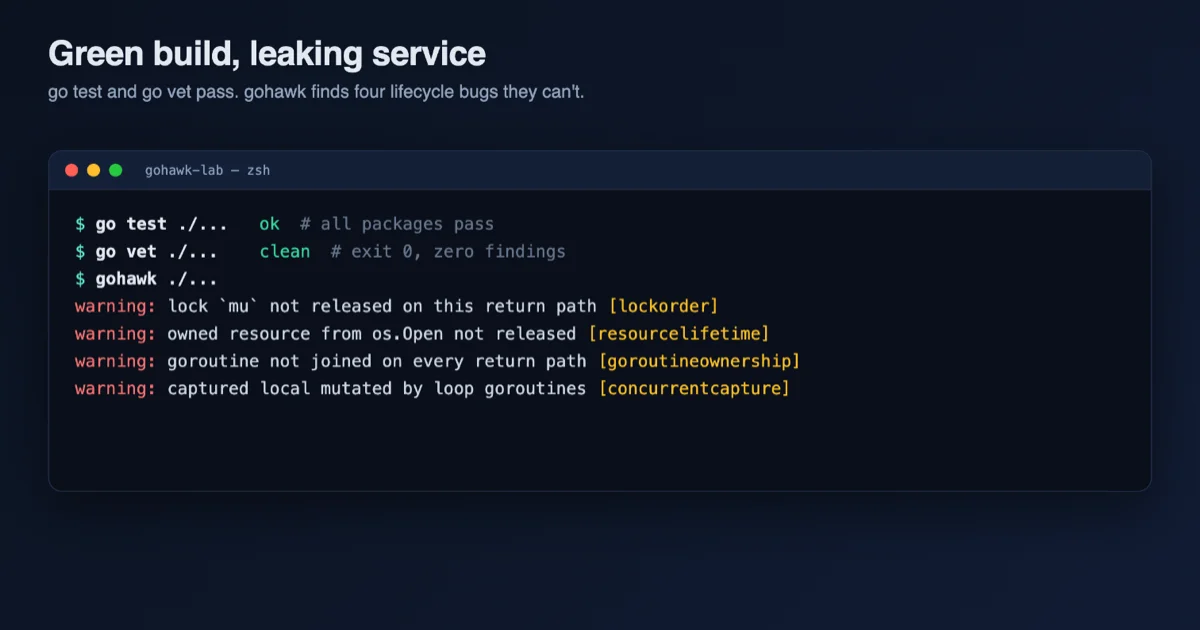
A terminal showing go test and go vet passing while gohawk reports four warnings: lockorder, resourcelifetime, goroutineownership, and concurrentcapture

Green Build, Leaking Service: Static Analysis for Go Concurrency and Resource Bugs with gohawk

A Go service can pass every test, clear go vet without a word, and still be quietly broken. The kind of bug I mean does not throw an exception or fail an assertion. It leaks. A file handle that never gets closed, a goroutine that nobody waits for, a lock that an early return skips over. Each one is invisible on a laptop with a single request in flight, and each one turns into a 3 a.m. incident once real traffic arrives: file descriptors exhausted, memory climbing with abandoned goroutines, a handler wedged on a lock that was never released. ...
November 6, 2026 · 21 min · Scott Algatt
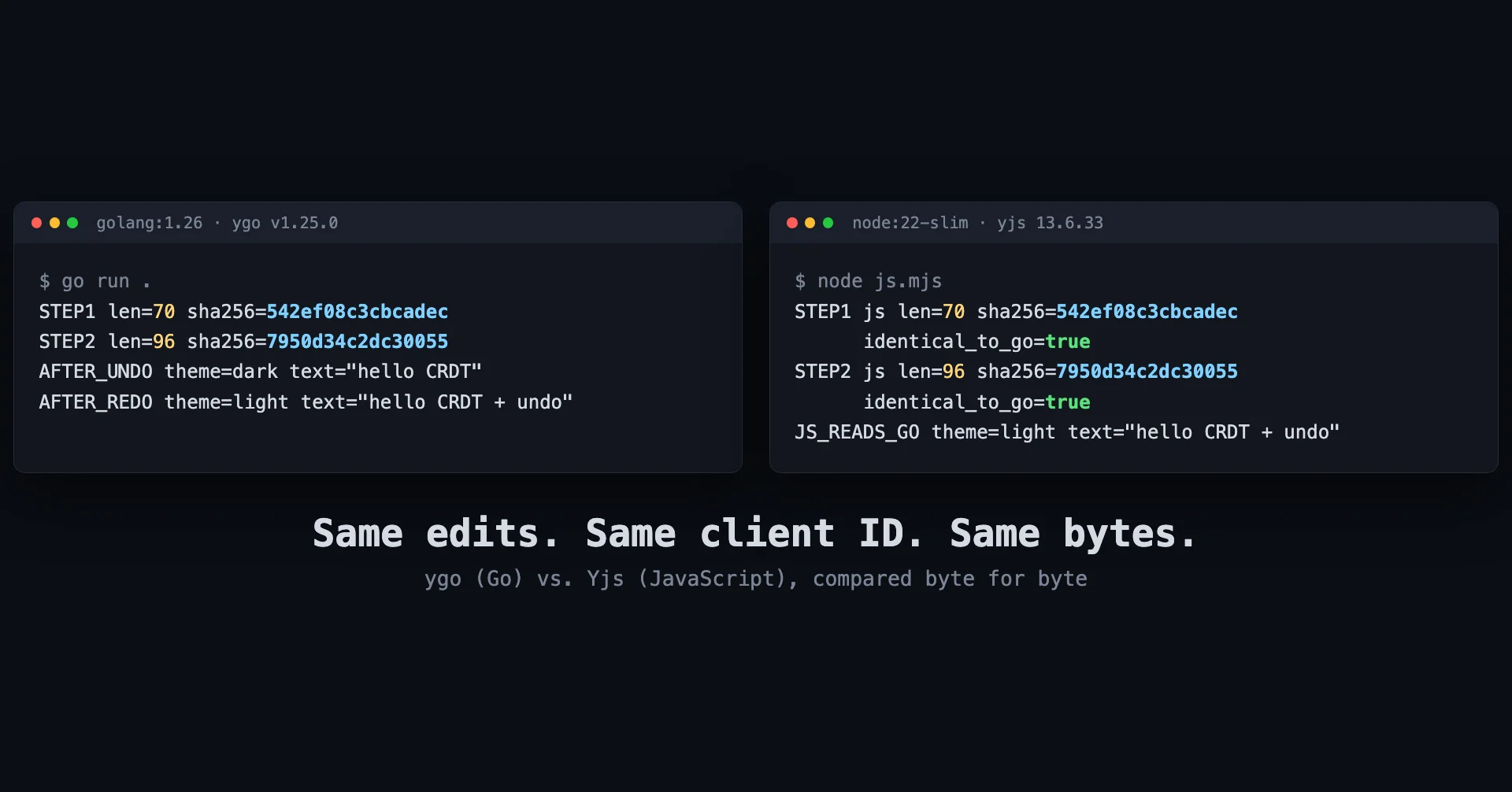
Two terminal panes side by side: a Go program using ygo prints a 96-byte update with sha256 7950d34c2dc30055, and a Node.js script using yjs 13.6.33 prints the same length and hash with identical_to_go=true

Same Bytes, Different Language: Testing ygo's Claim of Byte-for-Byte Yjs Compatibility

Every real-time collaborative editor has the same hard problem underneath it. Two people type into the same paragraph at the same moment, possibly while one of them is offline on a train, and when everything reconnects both screens have to end up showing exactly the same text without anyone’s edit vanishing. The family of data structures built to solve that is called a CRDT (Conflict-free Replicated Data Type): a structure designed so that copies of a document (called replicas) can accept edits independently and always merge to the same result, in any order, with no central referee deciding who wins. ...

October 16, 2026 · 19 min · Scott Algatt