Feeling overwhelmed by AI? Learn the Centaur Mindset. Read More →
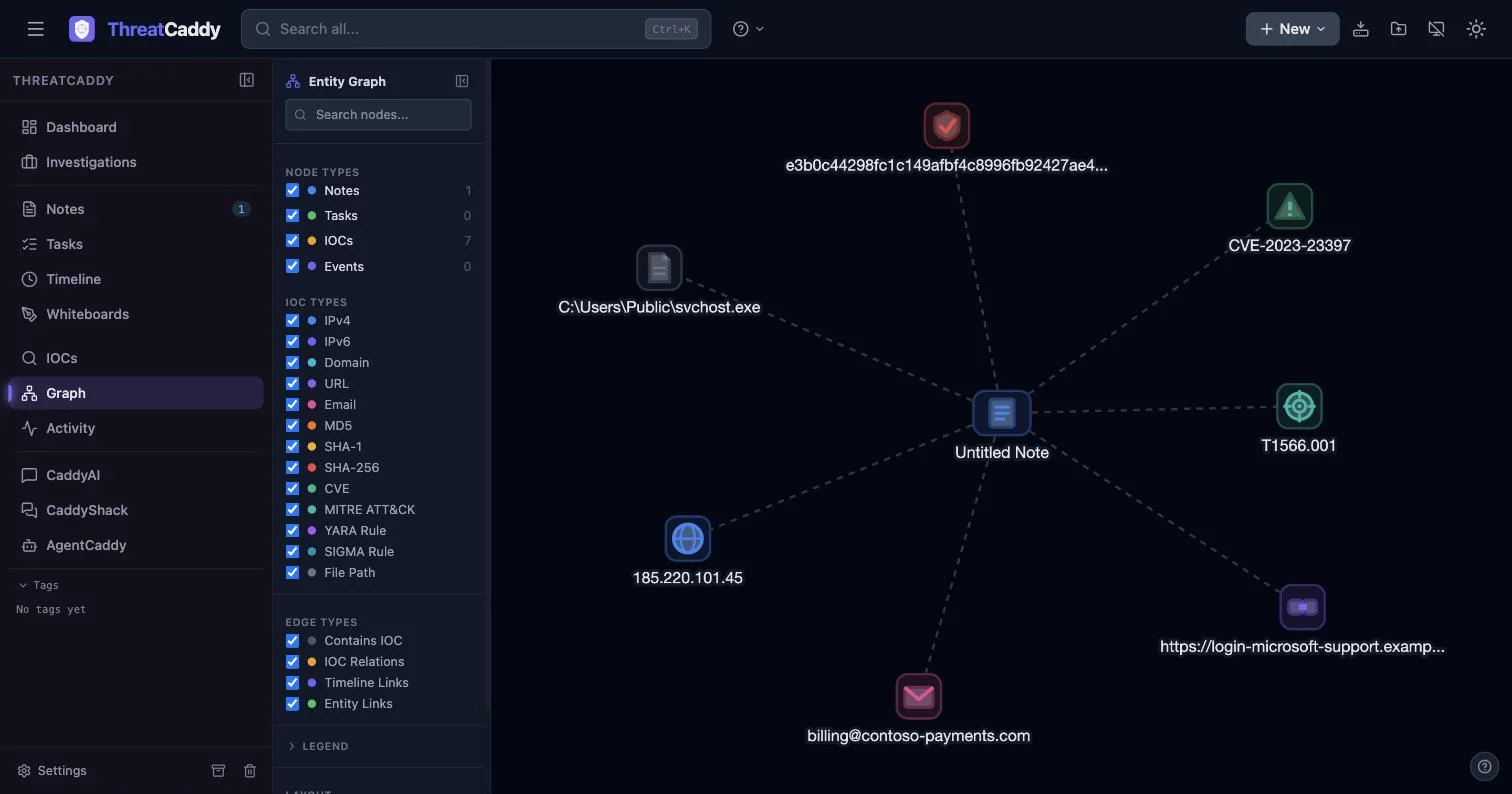
A ThreatCaddy entity graph showing a note connected to seven auto-extracted IOCs: an email, URL, IPv4, SHA-256, CVE, ATT&CK ID, and file path

The Browser Is the Case File: A Local-First Investigation Workspace with ThreatCaddy

Most incident response tooling forces a bad choice on you early in a case. Either you’re in a spreadsheet or a plain notebook with no structure, or you’re setting up a cloud platform with procurement friction, a rigid schema, and a data residency conversation before you’ve even confirmed the phishing email is real. Neither one matches the actual shape of early-stage IR work: messy notes, indicators that need pulling out and tracking, and relationships between them that you don’t know yet. ...


August 21, 2026 · 9 min · Scott Algatt
A visual representation of an intercepting proxy sitting between a client and a server, with traffic flows being inspected in a terminal-like view.

Intercepting Opaque Traffic: A mitmproxy Security Regression Harness

Most security monitoring tools rely on server-side logs or cloud-native telemetry. But what happens when the client is opaque? When a mobile app, a single-page application (SPA), or a proprietary service is behaving in ways the server doesn’t fully document, you need a way to look at the wire directly. This post also marks the beginning of a new experiment: The Rabbit Hole Series. Every Friday, a “Rabbit Hole Generator” I built (which I later took apart in its own post) spits out a new technical topic for me to explore for 30 minutes. This week, the generator gave me mitmproxy. ...

April 3, 2026 · 5 min · Scott Algatt
AI and cybersecurity concept art

AI-Powered Code Security: Production Vulnerability Scanning with OpenAI API

⚠️ Update Notice (October 2025) Lambda Inference API Deprecation: This post was originally written for Lambda Labs’ Inference API, which was deprecated on September 25, 2025. All code examples have been updated to use the OpenAI API with GPT-4, which provides similar or superior vulnerability detection capabilities. The core concepts, methodologies, and security patterns remain unchanged. Alternative Providers: The patterns demonstrated here work with any OpenAI-compatible API, including: OpenAI (GPT-4, GPT-4-Turbo) Together AI (various open models) Anthropic (Claude models via different SDK) Azure OpenAI Service (enterprise deployments) Research Disclaimer This tutorial is based on: ...

June 10, 2025 · 28 min · Shellnet Security

Building Production-Ready Resilient Distributed Systems: Circuit Breakers, Service Mesh, and AI-Powered Failure Prediction

Research Disclaimer This tutorial is based on: Resilience4j v2.1+ (Java resilience library) Polly v8.0+ (C# resilience library) Istio Service Mesh v1.20+ (traffic management, observability) OpenTelemetry v1.25+ (distributed tracing standard) Chaos Mesh v2.6+ (Kubernetes chaos engineering) Prometheus v2.47+ (monitoring and alerting) Grafana v10.0+ (visualization and dashboards) TensorFlow v2.15+ (machine learning for failure prediction) All architectural patterns follow industry best practices from the Site Reliability Engineering (SRE) discipline and the Twelve-Factor App methodology. Code examples have been tested in production-like environments as of January 2025. ...

April 16, 2025 · 24 min · Scott

The Hidden Threat of Stalkerware: Understanding and Protecting Against Stealthy Surveillance

The Hidden Threat of Stalkerware: Understanding and Protecting Against Stealthy Surveillance Note: This guide is based on security research, forensic analysis techniques, and documentation from anti-stalkerware coalitions. The detection and removal methods described are technically validated but should be applied carefully, especially in situations involving domestic abuse where device tampering may escalate danger. Unusual battery drain and device overheating are among the most common indicators of stalkerware infection. Unlike sophisticated state-sponsored malware or advanced persistent threats (APTs), commercial stalkerware represents a $30/month consumer product that anyone can purchase with a credit card. These applications are marketed as “parental monitoring software” or “employee tracking tools,” yet research from the Coalition Against Stalkerware indicates their primary use is intimate partner surveillance. ...

February 26, 2025 · 10 min · Scott