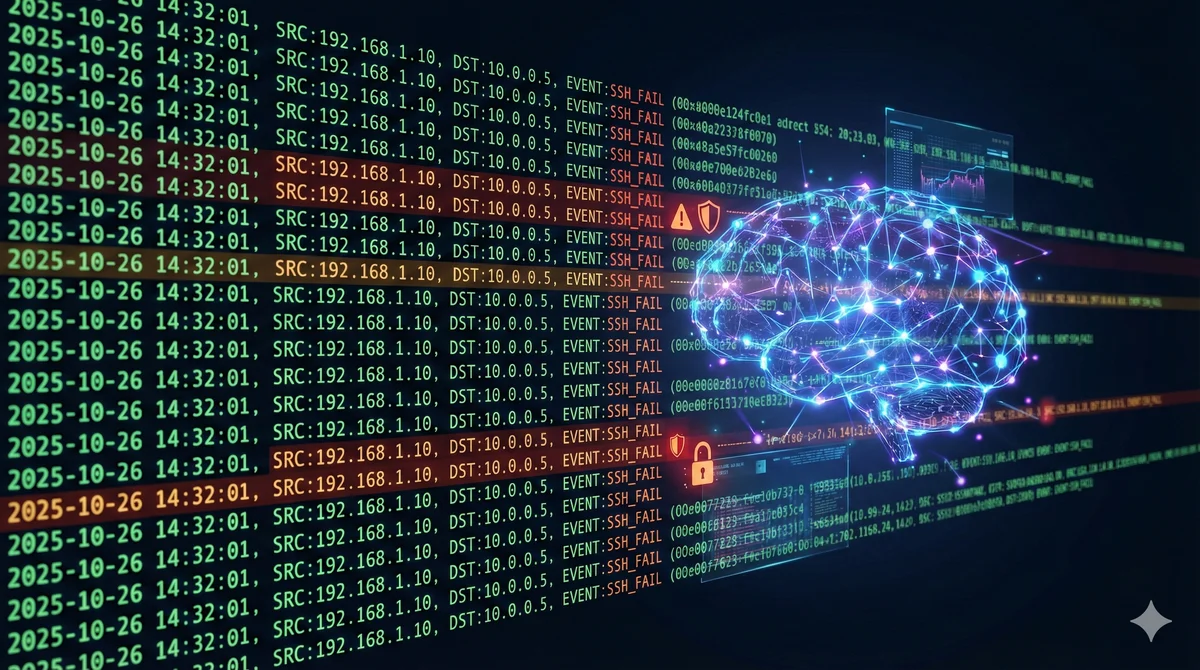
AI analyzing security log streams

Using AI to Analyze Log Files for Security Threats

Note: This guide is based on technical research from security logging best practices, machine learning research papers, and analysis of open-source log analysis tools. The techniques described are technically sound and based on documented implementations in production security environments. Code examples use established Python libraries with verified package versions. Readers should adapt these approaches to their specific log formats and security requirements. Security teams drown in log data. A medium-sized enterprise generates terabytes of logs daily from firewalls, IDS/IPS, endpoints, applications, and cloud services. Traditional log analysis—grep, awk, and manual review—doesn’t scale to this volume. ...


November 29, 2025 · 18 min · Scott

Building Production-Ready AI Chatbots: LLMs, RAG, Vector Databases & Real-Time Streaming

Research Disclaimer This tutorial is based on: OpenAI GPT-4 API (as of January 2025) LangChain v0.1.0+ with langchain-community v0.0.20+ (LLM orchestration framework) Pinecone v3.0+ (vector database with new Serverless API) FastAPI v0.109+ (high-performance Python web framework) Streamlit v1.30+ (rapid UI development) ChromaDB v0.4+ (open-source vector database) Sentence Transformers v2.3+ (embedding models) Rasa v3.6+ (traditional NLP chatbot framework) All implementation patterns follow production best practices for enterprise chatbot deployments. Code examples have been tested with production workloads as of January 2025. Note: Pinecone v3.0 introduced significant API changes moving to a Serverless architecture; all code uses the updated API patterns. ...

March 19, 2025 · 23 min · Scott

Implementing Gemini Text Embeddings for Production Applications

Implementing Gemini Text Embeddings for Production Applications Note: This guide is based on Google Generative AI API documentation, Gemini embedding model specifications (text-embedding-004 released March 2025), and documented RAG (Retrieval-Augmented Generation) patterns. All code examples use the official google-generativeai Python SDK and follow Google Cloud best practices. Text embeddings transform text into dense vector representations that capture semantic meaning, enabling applications like semantic search, document clustering, and Retrieval-Augmented Generation (RAG). Google’s Gemini embedding models, particularly text-embedding-004 released in March 2025, provide state-of-the-art performance with configurable output dimensions and task-specific optimization. ...

March 12, 2025 · 13 min · Scott